What Is a Trailer Chassis? A Guide for OEM Buyers
A trailer chassis is the structural foundation of a trailer. It supports the trailer body, suspension, axle system and other components while transferring the load to the wheels and towing connection.
For OEM trailer manufacturers, the chassis is more than a steel frame. Its dimensions, materials, mounting points, axle configuration, load capacity and surface treatment all need to work together with the final trailer design.
Whether you are developing a camper trailer, tiny house trailer, utility trailer, flatbed trailer or a specialized equipment trailer, choosing the right trailer chassis is an important step in the manufacturing process.
This guide explains what a trailer chassis is, the main components involved, how it differs from a trailer frame, and what OEM buyers should consider when sourcing a custom trailer chassis.
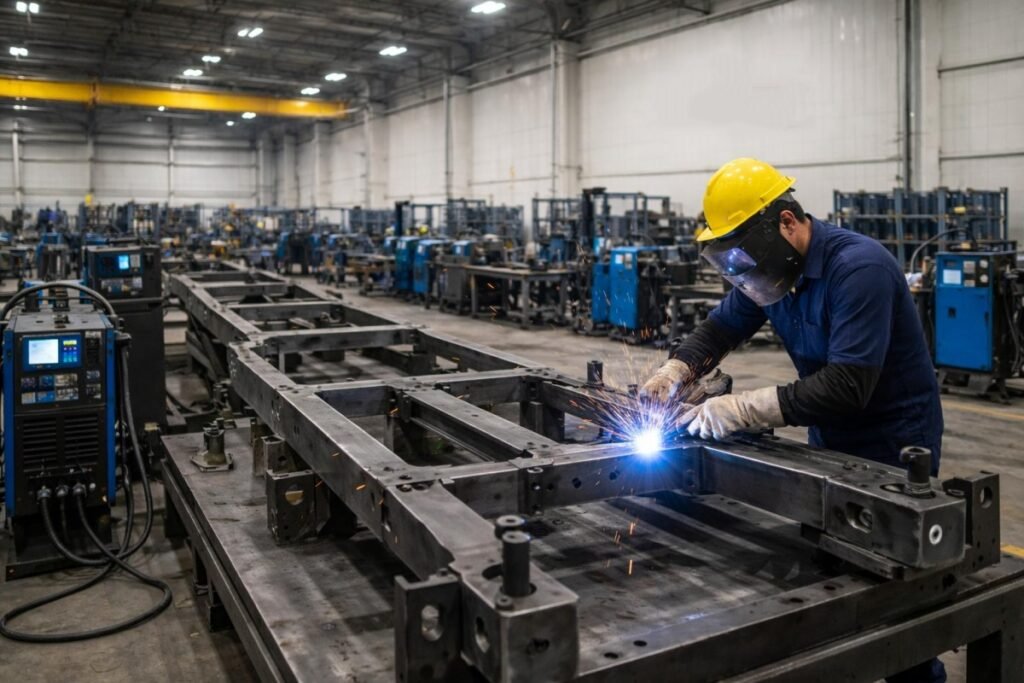
What Is a Trailer Chassis?
A trailer chassis is the main structural assembly that forms the foundation of a trailer.
It typically consists of longitudinal frame members, crossmembers, drawbar or A-frame sections, mounting brackets and other structural components required to support the trailer body and running gear.
Depending on the trailer design, the chassis may also incorporate mounting provisions for:
Axles and suspension
Brake components
Trailer body or floor
Coupler and towing system
Jockey wheels or trailer jacks
Stabilizer legs
Toolboxes and battery boxes
Mudguards and other accessories
Specialized equipment
For OEM applications, the chassis is normally designed around the requirements of the complete trailer rather than treated as an isolated component.
The body dimensions, expected payload, axle configuration, towing system and intended application all influence the chassis design.
What Does a Trailer Chassis Do?
The primary function of a trailer chassis is to provide a strong and stable structural foundation for the trailer.
A properly designed chassis performs several important functions.
1. Supports the Trailer Load
The chassis transfers the weight of the trailer body, cargo and equipment through the structural members and suspension system to the axles and wheels.
The required load capacity depends on the complete trailer configuration rather than the chassis alone.
2. Connects Major Trailer Components
The chassis provides mounting points for major components such as axles, suspension, brakes, couplers, body structures and other equipment.
Accurate mounting positions are therefore important for final assembly.
3. Maintains Structural Stability
A trailer chassis needs to withstand the forces generated during towing, braking, cornering and operation on different road surfaces.
The structural design therefore needs to consider not only static weight but also the operating conditions of the finished trailer.
4. Provides the Foundation for the Trailer Body
The trailer body, deck, enclosure or specialized equipment is installed onto the chassis.
For OEM manufacturers, this means that chassis dimensions and mounting interfaces must match the body design accurately.
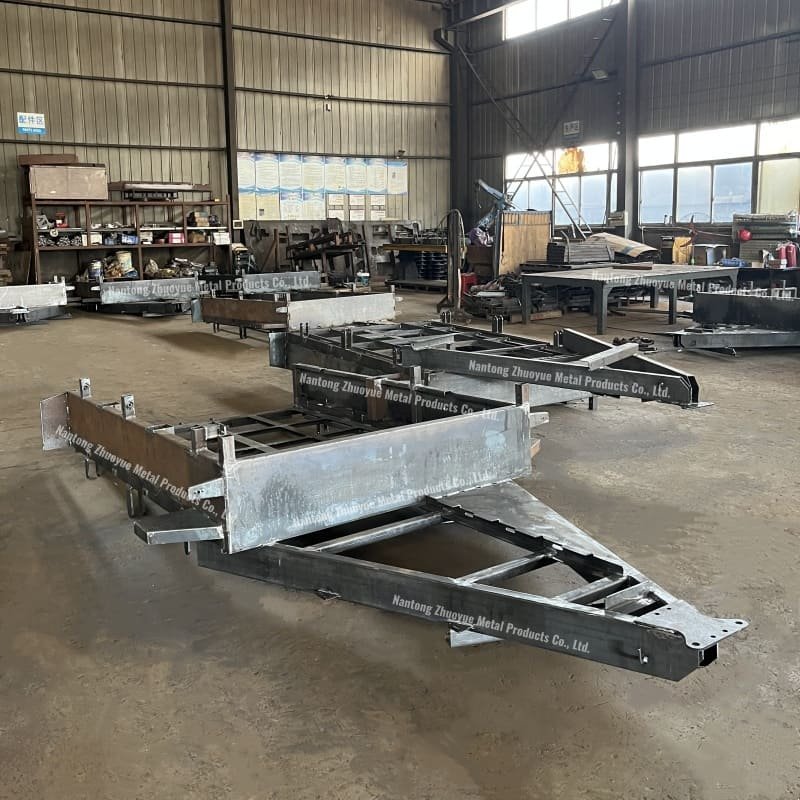
What Are the Main Components of a Trailer Chassis?
The exact configuration varies according to trailer type and application, but a typical trailer chassis may include several key structural elements.
Main Frame Rails
The main frame rails are the primary longitudinal structural members of the chassis.
They run along the length of the trailer and provide the main load-bearing structure.
The size, material and configuration of the main rails depend on the trailer dimensions, load requirements and overall design.
Crossmembers
Crossmembers connect the main frame rails and help maintain the shape and rigidity of the chassis.
Their spacing and design can vary depending on:
Trailer length
Floor construction
Payload requirements
Body structure
Axle position
Intended application
Drawbar or A-Frame
The drawbar connects the trailer chassis to the towing vehicle.
For many small and medium trailers, an A-frame or drawbar forms the front section of the chassis and provides the mounting structure for the coupler.
Axle and Suspension Mounting Points
The chassis needs appropriate mounting interfaces for the selected axle and suspension system.
The position of these mounting points affects weight distribution, trailer balance and the overall running gear configuration.
Body Mounting Points
OEM trailer manufacturers often require specific mounting holes, brackets or structural interfaces so that the trailer body can be installed efficiently.
These interfaces should be confirmed during the engineering stage before production.
Additional Mounting Structures
Depending on the application, the chassis may include additional structures for battery boxes, toolboxes, stabilizers, mudguards, spare wheels or specialized equipment.
This is particularly important for custom and equipment trailers.
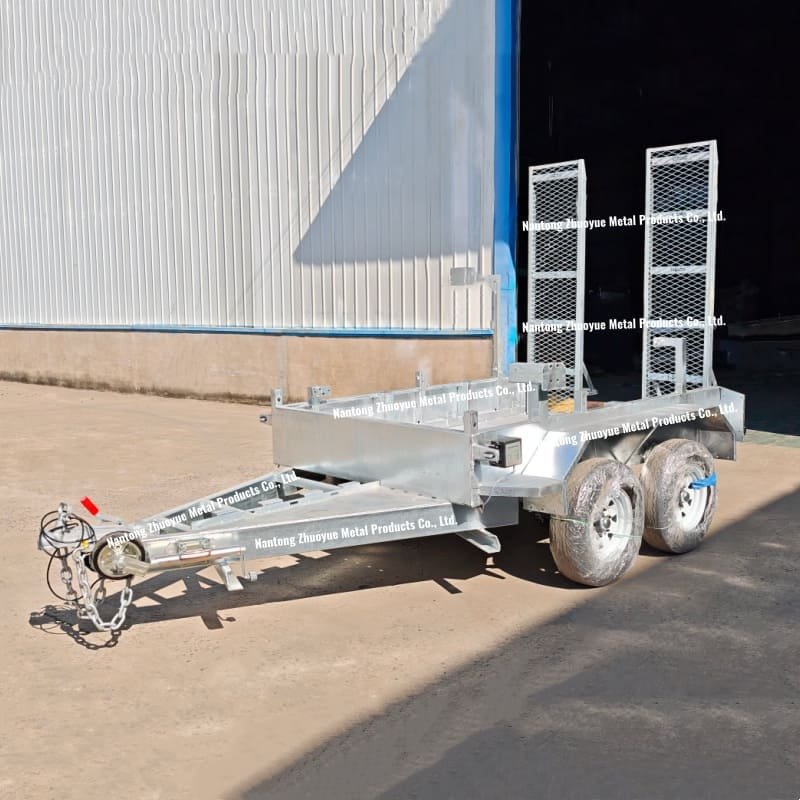
Trailer Chassis vs. Trailer Frame: What Is the Difference?
The terms trailer chassis and trailer frame are often used interchangeably, but their meaning can vary depending on the industry and application.
In general, a trailer frame refers primarily to the structural framework, while a trailer chassis can refer to the broader structural base of the trailer and its interfaces with running gear and other components.
For OEM projects, the more important question is not which term is used, but what is included in the supplied assembly.
For example, an OEM buyer may source:
A welded frame only
A chassis with drawbar
A chassis with axle and suspension mounting provisions
A complete rolling chassis
A chassis with running gear
A complete trailer structure ready for further assembly
When requesting a quotation, it is therefore important to clearly define the scope of supply.
What Types of Trailers Use Custom Chassis?
Trailer chassis are used across many different trailer applications.
Camper Trailer Chassis
Camper and caravan chassis are designed to support a recreational body while maintaining suitable weight distribution and towing characteristics.
The chassis may include specific mounting points for the camper body, suspension, storage systems and other equipment.
Tiny House Trailer Chassis
Tiny house trailers require a chassis designed around the dimensions and weight distribution of the structure installed above it.
Floor support, crossmember arrangement, drawbar design and axle positioning are important considerations during development.
Utility Trailer Chassis
Utility trailers may be used for transporting equipment, tools, materials, ATVs and other loads.
Depending on the application, the chassis may be configured for box, cage or flatbed bodies.
Flatbed Trailer Chassis
Flatbed trailers generally require an open structural platform capable of supporting distributed loads.
The frame design and crossmember arrangement depend on the required dimensions and payload.
Specialized Equipment Trailer Chassis
Some trailers are designed around specific equipment rather than general cargo.
Examples include traffic management equipment trailers, mobile surveillance trailers and other specialized platforms.
In these applications, the chassis may require additional structural reinforcement and equipment mounting interfaces.

What Should OEM Buyers Consider When Selecting a Trailer Chassis?
Selecting a trailer chassis should start with the requirements of the finished trailer.
Here are the main factors OEM buyers should confirm before requesting a quotation.
1. Trailer Dimensions
Provide the required:
Overall length
Overall width
Chassis height
Drawbar length
Body mounting dimensions
Axle positions
Accurate dimensions allow the manufacturer to evaluate the structural configuration and production requirements.
2. Gross Trailer Weight and Payload
The manufacturer needs to understand the expected weight of the finished trailer and the required payload.
It is important to distinguish between:
Trailer tare weight — the weight of the trailer itself.
Payload — the additional load the trailer is designed to carry.
Gross trailer mass / gross vehicle weight — the maximum permitted total weight of the trailer in the applicable design or regulatory context.
These values should be confirmed before final chassis design.
3. Axle and Suspension Configuration
OEM buyers should specify whether the trailer uses:
Single axle
Tandem axle
Other axle configurations
Leaf spring suspension
Torsion suspension
Independent suspension
Other specified systems
The chassis needs to provide compatible mounting interfaces.
4. Material Requirements
The required material depends on the application and engineering design.
An OEM project may specify a particular structural steel grade, thickness or material standard.
The manufacturer should confirm the material specification before production rather than selecting a material solely based on price.
5. Surface Treatment
Trailer chassis are exposed to weather, road conditions and moisture.
Common surface treatment options include:
Hot-dip galvanizing
Powder coating
Painting
Other specified protective coatings
The appropriate treatment depends on the application, expected environment, appearance requirements and customer specifications.
6. Mounting Interfaces
This is one of the most important points for OEM buyers.
Before production, confirm all critical mounting interfaces, including:
Axle mounting points
Suspension mounting points
Coupler mounting
Body mounting holes
Toolbox mounting
Battery box mounting
Mudguard mounting
Stabilizer mounting
Electrical component mounting
A well-defined interface reduces assembly problems later in the production process.
7. Manufacturing and Assembly Requirements
OEM buyers should also consider how the chassis will be integrated into their own production line.
For example, you may require:
Fully welded chassis
Partially assembled chassis
Knock-down components
Chassis supplied with running gear
Chassis supplied ready for local assembly
The best supply model depends on your production process, shipping requirements and target market.
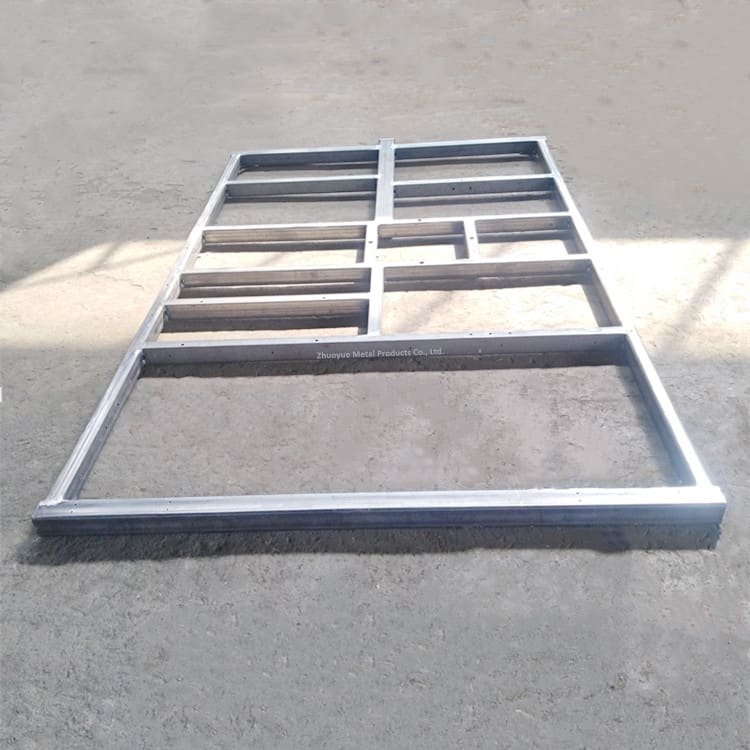
How Is a Custom Trailer Chassis Manufactured?
A typical OEM trailer chassis manufacturing process includes several stages.
Step 1: Requirements and Drawings
The manufacturer reviews the drawings, dimensions, payload requirements, materials and application specifications.
Step 2: Technical Confirmation
The chassis structure, mounting points, interfaces and production specifications are confirmed before manufacturing.
Step 3: Prototype or Sample
For new projects, a prototype or sample may be produced to verify key dimensions, structural details and assembly requirements.
Step 4: Chassis Fabrication
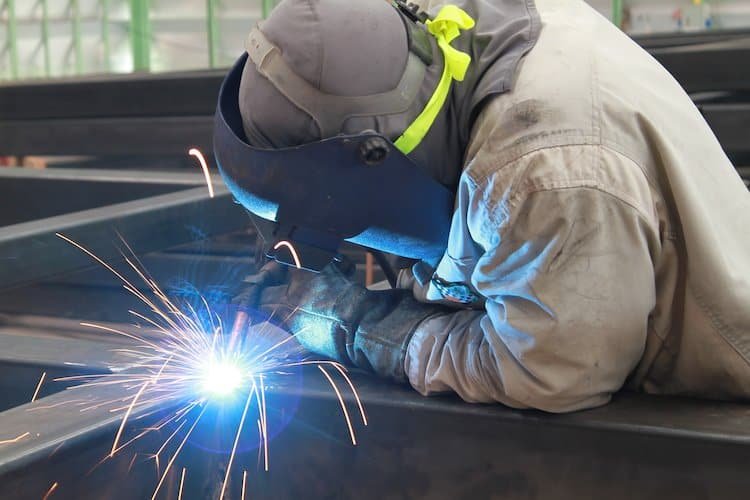
The approved design is manufactured using processes such as laser cutting, CNC bending, welding and structural assembly.
Step 5: Surface Treatment and Assembly
The chassis receives the specified surface treatment, such as hot-dip galvanizing or powder coating, followed by final assembly where required.
Step 6: Inspection and Shipment
The finished chassis is inspected according to the agreed requirements, then packed and prepared for export shipment.
For OEM buyers, this process helps establish a clear path from engineering requirements to repeat production.
Why OEM Buyers Often Choose Custom Trailer Chassis
A standard chassis may be suitable for some applications, but OEM manufacturers often need a chassis that fits their own trailer design.
Custom manufacturing can provide flexibility in:
Chassis dimensions
Drawbar configuration
Crossmember arrangement
Axle position
Suspension mounting
Body mounting
Equipment mounting
Surface treatment
Material specification
Assembly requirements
This allows the chassis to be developed around the finished trailer rather than forcing the trailer body to adapt to an unsuitable standard chassis.
What Information Should You Send to a Trailer Chassis Manufacturer?
If you are requesting an OEM trailer chassis quotation, providing complete technical information can significantly speed up the quotation and engineering process.
Ideally, provide:
Trailer type
Overall dimensions
Required payload
Target gross trailer weight
Chassis drawing or CAD file
Material specification
Axle and suspension requirements
Coupler specification
Body mounting requirements
Surface treatment
Estimated annual quantity
Target market or application
Required delivery terms
If a complete drawing is not available, an initial specification and reference drawing can still be useful for starting the technical discussion.
Frequently Asked Questions About Trailer Chassis
Is a trailer chassis the same as a trailer frame?
The terms are often used similarly, but the exact scope can vary. A trailer frame generally refers to the structural framework, while a trailer chassis may refer to the broader structural base and its interfaces with running gear and other components.
For OEM purchasing, always confirm exactly what is included in the supplier’s quotation.
Can a trailer chassis be customized?
Yes. OEM trailer chassis can be customized according to dimensions, payload requirements, mounting interfaces, materials, axle configuration and surface treatment.
What material is commonly used for trailer chassis?
Structural steel is widely used for trailer chassis, while the exact grade and thickness should be selected according to the engineering requirements of the finished trailer.
How do I choose the right trailer chassis?
Start with the complete trailer requirements, including dimensions, payload, gross weight, axle configuration, suspension, body design and intended application.
Can a manufacturer produce a chassis from my drawings?
Many OEM manufacturers can manufacture chassis based on customer drawings or technical specifications. Before production, the manufacturer should confirm the drawings, materials, tolerances and manufacturing requirements.
Can the chassis be supplied with axles and suspension?
Depending on the supplier and project scope, a chassis can be supplied as a welded frame or as a more complete assembly with running gear and other components.
What surface treatment is suitable for a trailer chassis?
Hot-dip galvanizing and powder coating are two common options. The appropriate treatment depends on the operating environment, corrosion requirements, appearance and customer specifications.
How do I request a quotation for a custom trailer chassis?
Provide the trailer dimensions, payload, target weight, drawings, material requirements, axle/suspension configuration, surface treatment and expected quantity.
The more complete the technical information, the easier it is for the manufacturer to evaluate the project accurately.
Final Thoughts
A trailer chassis is the structural foundation of the finished trailer, but choosing the right chassis involves more than selecting a steel frame.
For OEM buyers, the chassis needs to match the trailer body, running gear, payload requirements, mounting interfaces and manufacturing process.
Whether you are developing a camper trailer, tiny house trailer, utility trailer, flatbed trailer or specialized equipment trailer, starting with clearly defined chassis requirements can help reduce engineering changes and assembly problems later.
If you already have drawings or technical specifications, an experienced OEM trailer chassis manufacturer can help review the design, confirm the manufacturing requirements and develop a suitable production solution.
Looking for a custom trailer chassis for your next OEM project?
Contact Zhuoyue Metal to discuss your drawings, specifications and production requirements.